
20 Aug 2026 Trump Accounts – A Use Case?
Trump Accounts–also known as Section 530A accounts–were created as part of President Trump’s One Big Beautiful Bill Act (OBBBA), which was signed into law on July 4th, 2025. I wrote about these accounts a few weeks before the bill was passed and what I thought they would look like and what they actually look like are two very different things. To save you the time of reading a year-old post, my initial take was that they had limited appeal and it was hard to see where they fit with options like 529 accounts, custodial accounts, and Roth IRAs already in existence. Now that we know their ultimate design, is there a use case?
Design
Before diving into potential merits, here’s a high-level overview of how Trump Accounts are constructed. A legal guardian, parent, adult sibling, or grandparent, can open a Trump Account for a child at any time through the year they turn 17 (Daniel wrote a great brief explaining how to open an account). Each child can only have one Trump Account, and the order in which I presented who can open an account matters. That is, a grandparent cannot open an account for their grandchild if the grandchild’s parents are still living. They can contribute to it, but the parents need to create the account in the first place. Once opened, the account can be funded with up to $5,000 per year through until the year the child turns 18 (this is called the “growth period”).
In addition to contributions from mom and dad, grandparents, etc., the federal government will add $1,000 for any child born between January 1st, 2025, and December 31st, 2028. Also, employers can contribute up to $2,500 per employee, if they so desire. These contributions may be taxable at the state level in the year they are made, and count against the $5,000 annual contribution limit.
In general, contributions from parents, friends, family, etc., establish basis, while account growth and contributions from the U.S. Treasury or an employer do not. The former can be withdrawn or rolled over income tax-free, while the latter will be taxable and possibly subject to a penalty, if withdrawn or rolled over before 59 1/2.
Funds are required to be invested in a low-cost ETF that closely tracks the S&P 500. As of right now, there is only one approved fund, with another four-or-five on the way.
Once the child turns 18, they take full ownership. No additional contributions can be made and while still considered a Section 530A account, it takes on the nature of a Traditional IRA where growth is tax-deferred and any withdrawals taken before 59 1/2 will be subject to income tax plus a 10% penalty (the penalty can be avoided if it is a “qualified” withdrawal).
Use Case
Custodial accounts are the closest competitor, so today we’ll evaluate which is superior. Of course, time-frame matters, so we’ll consider long-term (retirement) and intermediate-term (early 20’s). As we evaluate, it’s important to note a few differences: custodial accounts are fully liquid once the child/young adult takes over between the ages of 18 and 21, and Trump Accounts offer tax-deferral. There are more but these are the ones that matter for today’s purposes.
First, parameters:
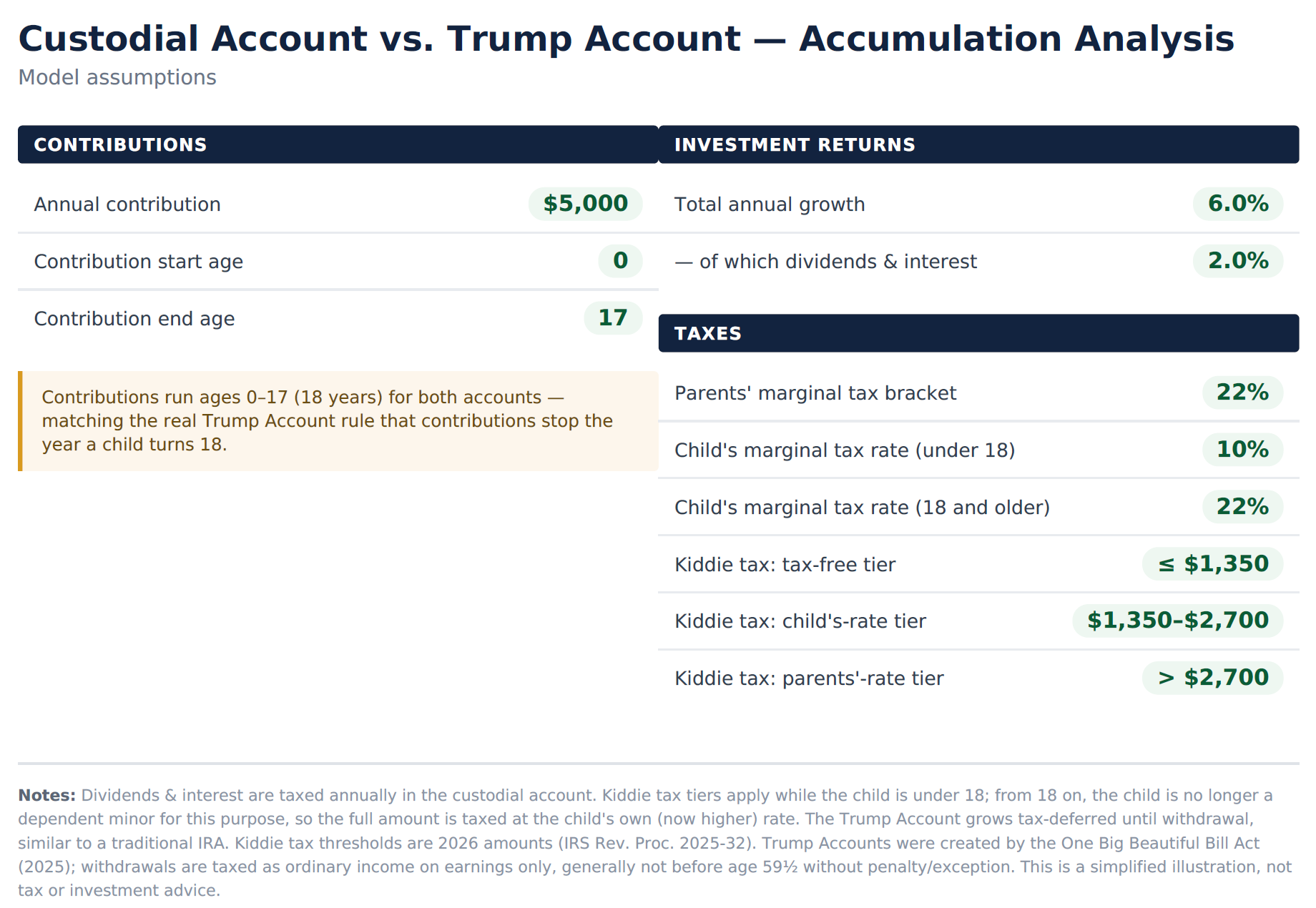
During the “growth period,” ages 0-17, the only difference here is taxation: Trump accounts are tax-deferred, while custodial accounts are taxable at different rates. As you can see, the first $1,350 of custodial account income is tax-free, the next $1,350 is taxable at the child’s rate (typically 0%, though I assume 10% in this example just to be conservative), with anything over taxed at the parents’ rate. Assuming that the custodial account generates 2% in income each year, by looking at the “Tier 2” column in the spreadsheet below you can see that the account doesn’t generate taxable income until the child is 10, i.e., tax-deferral doesn’t matter until the child reaches double-digits.
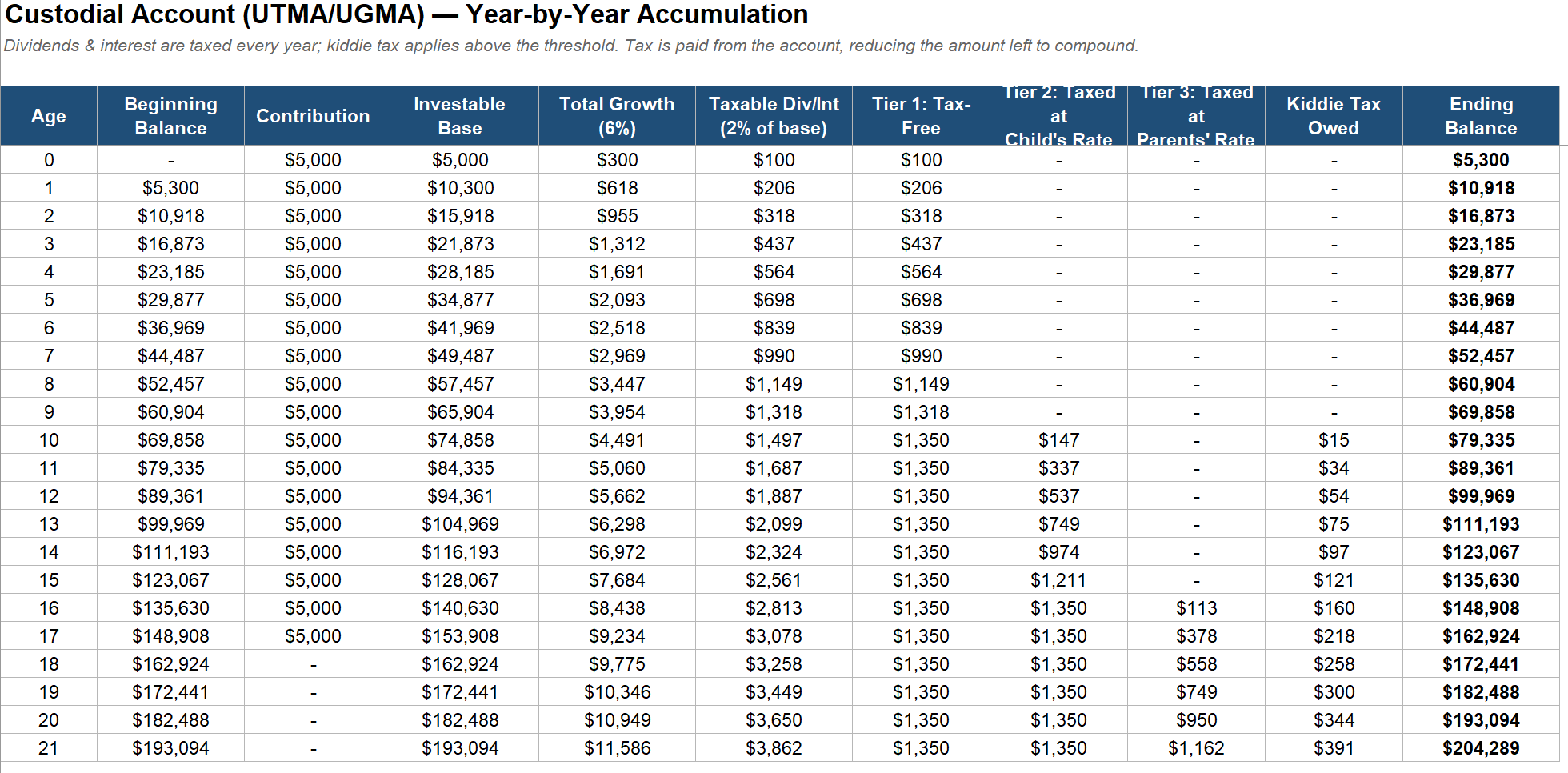
Looking further, taxes paid by this custodial account between 0-17 are roughly $2,000. Said another way: up until the age the child takes control, there’s very little difference in pre-tax value between a Trump Account and a custodial account.
But what if the owner wants to use the funds in their early 20’s? This is where you begin to see the limitations of the Trump Account. Withdrawals pre-59 1/2 trigger income tax and penalties on the growth, which are much less tax-efficient than the long-term capital gain treatment that the custodial account receives. As you can see, liquidating both accounts at age 21 results in the custodial account providing nearly $10,000 more.
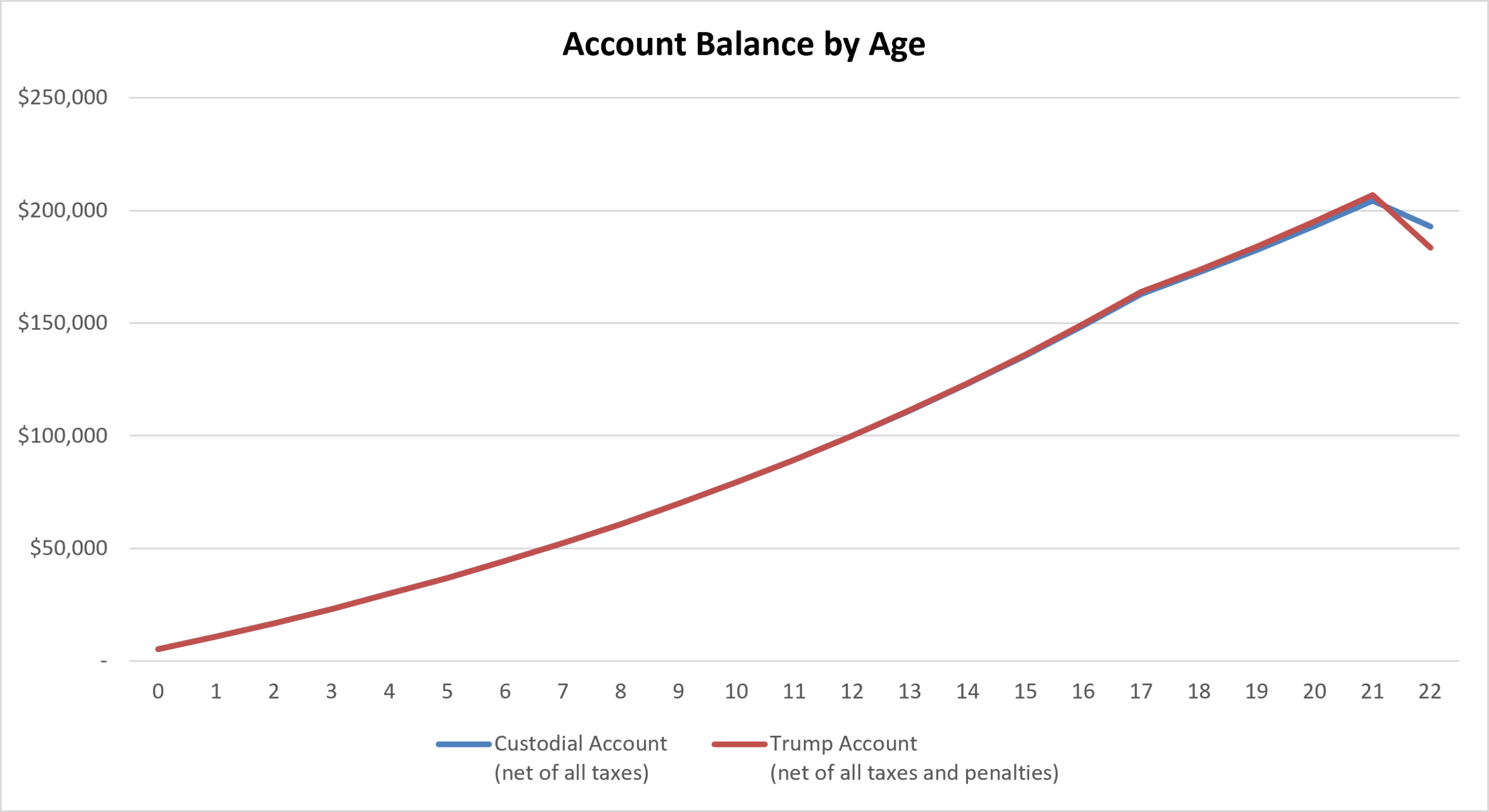
At least in the intermediate-term, it’s hard to make a case for a Trump Account. Yes, there is tax-deferral, but the income taxes and penalties that liquidation would trigger aren’t enough of an incentive to forego the liquidity that a custodial account offers. But what about for long-term planning? A strategy you may have read about proposes maximum annual contributions from age 0-17 and then sometime around age 22 when the young adult, now the account owner, begins to file their own tax return, convert the account to a Roth IRA. The conversion can be done all at once, though it’s probably more efficient to do it over a period of years while being mindful of tax brackets. (Before converting, consider the following: will the income hit the parents’ tax return or the child’s? And, if the child is still in college, will it impact financial aid?) This is a strategy that may make sense in that the conversion is performed when the owner is in a relatively low tax-bracket. Here’s what it looks like long-term:

As you can see, the long-term after-tax value of a Roth IRA, née Trump Account, is significantly more than a custodial account: $2.35M vs. $1.9M, respectively.
Conclusion
Is there a use case for a Trump Account? Yes, though my opinion hasn’t changed much from what I wrote a year ago. Trump accounts mimic Traditional IRAs when the child turns 18 and because of that, it is easiest to think about them as another way to save for retirement. They are bad in the short-to-intermediate term (a meaningful benefit doesn’t materialize until the owner is in his or her mid-to-late 40’s), but worthwhile long-term.
Whether or not you open one depends on two things: Do you qualify for the $1,000 contribution, and what are you trying to help with? If the answer to the latter question is college, buying a house, starting a business, or simply giving your child financial margin in their early 20’s, stick with a 529 or a custodial account. If providing a head start on retirement is the goal, a Trump Account may be the way to go.
The content above is for informational and educational purposes only. The links and graphs are being provided as a convenience; they do not constitute an endorsement or an approval by Beacon Wealthcare, nor does Beacon guarantee the accuracy of the information.
